 United StatesJFK
 MexicoMEX
 BrazilGRU
 ArgentinaEZE
 ChileSCL
 ColombiaBOG
 PeruLIM
 PanamaPTY
 Costa RicaSJO
 Dominican RepublicPUJ
 JamaicaMBJ
 BahamasNAS
 BarbadosBGI
 United KingdomLHR
 IrelandDUB
 FranceCDG
 GermanyFRA
 NetherlandsAMS
 BelgiumBRU
 SwitzerlandZRH
 AustriaVIE
 ItalyFCO
 SpainMAD
 PortugalLIS
 GreeceATH
 TurkeyIST
 DenmarkCPH
 SwedenARN
 NorwayOSL
 FinlandHEL
 PolandWAW
 Czech RepublicPRG
 HungaryBUD
 IcelandKEF
 United Arab EmiratesDXB
 QatarDOH
 Saudi ArabiaRUH
 IsraelTLV
 EgyptCAI
 MoroccoCMN
 South AfricaJNB
 KenyaNBO
 NigeriaLOS
 IndiaDEL
 PakistanLHE
 Sri LankaCMB
 SingaporeSIN
 MalaysiaKUL
 ThailandBKK
 VietnamSGN
 PhilippinesMNL
 IndonesiaCGK
 Hong KongHKG
 ChinaPVG
 TaiwanTPE
 JapanHND
 South KoreaICN
 AustraliaSYD
 New ZealandAKL
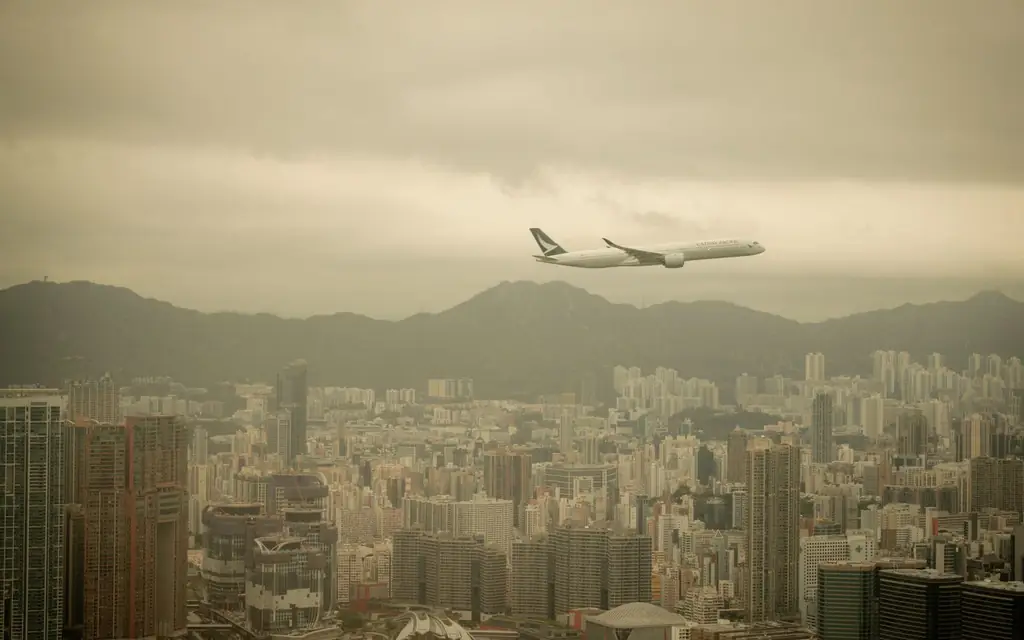
Hong Kong International Airport is not on the mainland side of the harbour at all. It stands on reclaimed land beside Chek Lap Kok on the north coast of Lantau Island, which means every arrival crosses water on a long bridge or a tunnel before reaching a hotel in Central, Wan Chai or Tsim Sha Tsui. The distance to Central is about 35 km (22 mi), and the quickest way to cover it is the Airport Express train. That is the honest starting point for any Hong Kong airport transfer, and this page then explains where a private car is the better answer: a family with strollers, four travellers with full suitcases, a late-night landing, a hotel on a steep street that is awkward from the station, or a trip that carries on to Macau or Zhuhai.
What is the best Hong Kong airport transfer to your hotel?
For one or two travellers with light bags and a hotel near Hong Kong or Kowloon station, the Airport Express is the fastest option at about 24 minutes. For three or more people, children, heavy luggage, a late arrival or a hotel away from a station, a pre-booked private car gives you one door-to-door ride at a fixed fare quoted before you pay.
Hong Kong is a city where the public option is genuinely good, so this page does not pretend otherwise. The question is what happens after the train: a taxi queue, or a walk with bags through a station concourse. A private transfer replaces that with a single leg, and it matters most when the group is large or the hotel sits away from the rail line.
Hong Kong airport to the city: every option compared
| Mode | Door-to-door time | Cost note | Luggage | Best for |
|---|---|---|---|---|
| Airport Express to Hong Kong or Kowloon station | About 24 min on the train, 40 – 60 min with the hotel leg | Fare set by the rail operator; check before you travel | Trolleys on board; stairs and escalators at stations | One or two travellers, hotels near stations |
| Red urban taxi from the airport rank | 35 – 60 min | Metered; HK$6 per bag and tunnel or bridge charges apply | Boot space for most bags | Spontaneous trips, hotels on Hong Kong Island or Kowloon |
| Airport bus (A routes) | Varies by route and stop | Fixed bus fare | Limited by seats and aisle | Solo travellers with one bag and no time pressure |
| Cross-boundary shuttle from the Hong Kong Port | 40 – 60 min plus border formalities | HK$65 daytime single fare (Transport Department, as of 2026) | Carry your own bags through immigration | Travellers heading to Macau or Zhuhai |
| Pre-booked private car | 35 – 60 min | Fixed fare via booker | Everything in the boot | 3+ travellers, children, heavy bags, late arrivals, Lantau and New Territories hotels |
The train wins on speed and predictability, and it is not a close contest for a solo traveller staying next to a station. The car wins on convenience for groups. Four people with four big cases and four carry-ons do not turn a train journey into a pleasant one, and the taxi rank sorts them into two cabs, so the group splits up and pays twice.
When the Airport Express is the better choice
Take the train when your hotel is within a few minutes of Hong Kong station in Central or Kowloon station near Elements and the harbour, when you have one carry-on and one bag, and when you land at a sensible hour. You will not be slowed by road traffic, and the journey time stays the same at 8 am and at 6 pm. The airport's own page puts the trip to Central at 24 minutes, and that holds whether you land at noon or at 11 pm, provided the train is running.
The train stops being the better answer in three situations. First, when the last train has gone and the first has not yet started, because rail does not run through the small hours. Second, when you are not going to a station: Causeway Bay, Wan Chai, Mid-Levels, the Peak, Sheung Wan and Tsim Sha Tsui all need a taxi, a bus or a walk after the train. Third, when you are travelling with children or elderly relatives and every extra transfer matters.
Taxis in Hong Kong: colours, tariffs and tolls
Hong Kong has three taxi types, and the colour tells you where each one may operate. Red urban taxis serve most of Hong Kong Island, Kowloon and the New Territories. Green New Territories taxis stay in the northern districts. Blue Lantau taxis stay on the island. If you step into a blue taxi at the airport, it will take you around Lantau but not across to Central.
The Transport Department publishes the tariff. A red urban taxi starts at HK$29 for the first 2 km, then adds HK$2.10 for each 200 m or minute of waiting until the fare reaches HK$102.50, after which each step is HK$1.40 (as of 2026, effective July 2024). Baggage in the boot or oversize luggage in the cabin adds HK$6 per piece. Cross-harbour tunnels add a toll of HK$25, with a return toll of HK$25 that is waived when the trip starts at a cross-harbour stand or ends on the same side. A taxi from the airport to Central or Tsim Sha Tsui therefore costs the meter plus bags plus any tunnel charge, and the total depends on route, traffic and waiting time.
Drivers do not always speak English, and the Government of Canada advises showing the address in Chinese characters, using only officially marked taxis, and insisting on the meter or an agreed fare. Taxi drivers are not obliged to give change for HK$500 or HK$1,000 notes, a detail worth knowing if you arrive with only large bills. A pre-booked car carries none of these variables, because the chauffeur has your address in writing and the fare is already settled.
Which side of the harbour is your hotel on?
The Hong Kong airport transfer to your hotel depends on where the hotel is, because the harbour divides the city into two driving zones.
- Kowloon side (Tsim Sha Tsui, Jordan, Mong Kok, Kowloon station): the road runs from the airport across the Lantau Link and down the West Kowloon corridor. No harbour tunnel is involved, so the trip is typically 35 – 55 minutes, and the Airport Express to Kowloon station is the fastest rail alternative.
- Hong Kong Island (Central, Admiralty, Wan Chai, Causeway Bay): the car crosses the harbour through one of the cross-harbour tunnels or uses the western route. Expect 40 – 60 minutes, with the tunnel queues heavier at the evening peak.
- Lantau (Tung Chung, Disneyland resort hotels, Discovery Bay approaches): a short run of 10 – 30 minutes, which is where a car is far easier than the train and bus combination.
- New Territories (Sha Tin, Tuen Mun, Tai Po): often reached through the Tuen Mun to Chek Lap Kok link or the Tai Lam corridor; allow 40 – 70 minutes.
Where you meet your driver at Hong Kong International Airport
Arrivals at Hong Kong International Airport come out into a single large hall, and your airline decides which gate you use. Your confirmation shows the arrivals hall for your flight, and the chauffeur is told the same. After immigration and baggage reclaim, you walk into the public arrivals hall where the chauffeur waits.
On request, the chauffeur holds a name board inside arrivals, with an alias name printed instead of yours if you prefer privacy. Your flight is tracked, so a delay moves the pickup. After an international landing, 60 minutes of waiting are included, 30 after a domestic one, and 15 minutes on other pickups. Bag reclaim on a heavy evening wave can run long, and the tracking covers it.
Hong Kong airport transfer to your hotel: how the booking works
Onroutz.ca is a Toronto-based desk. In Hong Kong a vetted, licensed and commercially insured local transfer partner provides the vehicle and chauffeur. The booking, confirmation, 24/7 support and invoice come from the Toronto desk. That gives you one booking, one confirmation, one invoice and one contact line, even if the itinerary goes on to Singapore or Tokyo. The age limit for partner vehicles is four model years, extended to seven for Rolls-Royce, Bentley and Maybach. We do not own cars or offices in Hong Kong.
- Enter your flight number, hotel and the number of passengers and bags.
- See the fixed all-in fare for that exact pickup and drop-off before you pay.
- Keep the confirmation, which names the chauffeur and the meeting point.
- Land. The chauffeur is waiting, and the desk is available around the clock if something changes.
Vehicles and luggage for a Hong Kong arrival
Hong Kong hotel rooms are compact, and so are many streets near the hotel, so choose a vehicle by luggage as well as by headcount.
- Executive Sedan (Mercedes-Benz E-Class, Cadillac or similar): up to 3 passengers, 2 large and 2 cabin bags.
- First Class Sedan (S-Class, BMW 7 Series or similar): up to 3 passengers, with more space and refinement.
- Luxury SUV (Cadillac Escalade, GMC Yukon Denali, Chevrolet Suburban or similar): up to 6 passengers and 5 – 6 large bags.
- Executive Sprinter: up to 12 passengers and 12 bags, suited to a conference group or a family reunion.
Model confirmed at booking, "or similar". Ask for a Maybach, Rolls-Royce, stretch or armoured car and the desk confirms availability with the booking. Child seats come in infant, toddler and booster sizes and can be added to the booking. Water and phone charging are in most vehicles. See the fleet for the full line-up and the Sprinter van with driver page for group arrivals.
Macau, Zhuhai and the bridge from the airport
The Hong Kong Port of the Hong Kong-Zhuhai-Macao Bridge sits beside the airport. The Transport Department lists a SkyPier transfer coach at the airport for passengers with valid flight tickets who are continuing to Zhuhai or Macao, and a shuttle bus that runs 24 hours between the Hong Kong Port and the Zhuhai and Macao ports. The daytime single fare is HK$65 as of 2026. Border formalities apply at both ends, with immigration cleared in person.
A private car can take you to the Hong Kong Port, and both red, green and blue taxis may use its interchange. Vehicles that cross the boundary need a Closed Road Permit, so the car that drives you from the airport to the port is not the car that crosses the bridge. If your plans include Macau or Zhuhai, tell the desk at booking and we will explain the handover. Cross-boundary rides need special licences, and we confirm availability before quoting.
Entry rules and practical notes for visitors
The Hong Kong Immigration Department lists a visa-free stay of 90 days for Canadian, US and Australian passport holders, 180 days for British citizens, and a pre-arrival online registration for Indian nationals. Visitors must be able to support themselves and, unless transiting to Mainland China or Macao, hold an onward or return ticket. The Government of Canada requires a passport valid for at least one month beyond your departure date and notes that Mainland China visas are separate, so check multiple-entry options if you plan to cross the border.
Public transport is described as safe and reliable by the Government of Canada, with pickpocketing a risk on crowded services. Typhoon season runs through summer and into early autumn. When a No. 8 signal is raised, public transport and taxi availability can change quickly, and the desk reroutes or reschedules around official notices.
Planning more than the airport leg
Hong Kong is rarely a standalone stop. Many visitors combine it with Singapore Changi, Shanghai Pudong or Beijing Capital, and the Asia-Pacific hub lists every route we book in the region. The airport transfers hub shows airports worldwide. If you want a name-board welcome inside arrivals, read about airport meet and greet, and for a full day with a driver see the executive car service. Our guide to airport transfers versus taxis and rideshares puts the choices side by side, and how private airport transfers work explains each step.
Discretion is standard: no photos of clients, no posts about journeys, NDAs on request. Onroutz.ca is a transport service, not a security company: no armed drivers and no bodyguards, working alongside a client's own security team if there is one.
Official sources worth bookmarking
The Hong Kong Transport Department taxi fare page sets out the tariff, surcharges and tolls. The Immigration Department lists visa-free periods by nationality. The Transport Department's HZMB access page covers the bridge port, and the Government of Canada's Hong Kong travel advice covers entry, taxis and public transit. Confirm tariffs and schedules before you travel, as they change.
Frequently asked questions
How do I get from Hong Kong Airport to my hotel?
By Airport Express to Hong Kong or Kowloon station, by taxi, by airport bus or by a pre-booked private car. The airport is about 35 km (22 mi) from Central, and the car takes roughly 35 – 60 minutes depending on the hotel and traffic.
How long is the Airport Express from the airport to Central?
The Hong Kong Airport Authority describes the trip between the airport and Central as 24 minutes. The hotel leg from the station is extra, so allow another 10 – 30 minutes if your hotel is not at the station.
How much is a taxi from Hong Kong Airport to Central?
It is metered, so it depends on the route and traffic. The Transport Department tariff for red urban taxis starts at HK$29, adds HK$6 per bag, and adds tunnel tolls where they apply (as of 2026). For a fixed all-in figure, the booker shows our fare before you pay.
Can a taxi at Hong Kong Airport take me anywhere in the city?
Only red urban taxis serve Central and Kowloon. Green taxis stay in the northern districts, and blue taxis stay on Lantau. Check the colour before you board, and show the driver your address in Chinese characters if you can.
Is a private transfer from Hong Kong Airport worth it?
It is worth it for three or more travellers, children, heavy luggage, a late-night landing or a hotel away from a station. For a solo traveller with one bag and a hotel next to Hong Kong station, the Airport Express is faster and simpler.
Can you take me from Hong Kong Airport to Macau?
We can take you to the Hong Kong Port beside the airport, where the cross-boundary shuttle runs. A vehicle crossing the bridge needs a Closed Road Permit, so tell the desk at booking and we confirm the arrangement and any handover first.
What happens if my Hong Kong flight is delayed?
Your flight is tracked, so the pickup follows the real landing time. Waiting is free for 60 minutes after an international landing, 30 after a domestic one and 15 on other pickups, and the 24-hour desk can adjust anything else.
Do Canadians need a visa for Hong Kong?
No for stays up to 90 days, according to the Hong Kong Immigration Department and the Government of Canada. Your passport must be valid at least one month beyond your departure date, and Mainland China has its own entry rules.
What is your cancellation policy?
Cancel more than 72 hours before pickup and nothing is charged. Inside 72 hours the charge is 10%, inside 48 hours it is 50%, and inside 24 hours, or for a no-show, it is 100%, all counted from the scheduled pickup. Major events and conventions sometimes have their own deadline; when they do, it appears on the confirmation.