 United StatesJFK
 MexicoMEX
 BrazilGRU
 ArgentinaEZE
 ChileSCL
 ColombiaBOG
 PeruLIM
 PanamaPTY
 Costa RicaSJO
 Dominican RepublicPUJ
 JamaicaMBJ
 BahamasNAS
 BarbadosBGI
 United KingdomLHR
 IrelandDUB
 FranceCDG
 GermanyFRA
 NetherlandsAMS
 BelgiumBRU
 SwitzerlandZRH
 AustriaVIE
 ItalyFCO
 SpainMAD
 PortugalLIS
 GreeceATH
 TurkeyIST
 DenmarkCPH
 SwedenARN
 NorwayOSL
 FinlandHEL
 PolandWAW
 Czech RepublicPRG
 HungaryBUD
 IcelandKEF
 United Arab EmiratesDXB
 QatarDOH
 Saudi ArabiaRUH
 IsraelTLV
 EgyptCAI
 MoroccoCMN
 South AfricaJNB
 KenyaNBO
 NigeriaLOS
 IndiaDEL
 PakistanLHE
 Sri LankaCMB
 SingaporeSIN
 MalaysiaKUL
 ThailandBKK
 VietnamSGN
 PhilippinesMNL
 IndonesiaCGK
 Hong KongHKG
 ChinaPVG
 TaiwanTPE
 JapanHND
 South KoreaICN
 AustraliaSYD
 New ZealandAKL
Los Cabos has one airport and two very different ends of the coast. The airport sits inland near San José del Cabo, while the big resorts and the marina in Cabo San Lucas are a drive of 40 to 50 minutes further west. That gap is why Cabo airport transportation deserves some planning. Onroutz.ca arranges private transfers from Los Cabos airport to your hotel with a licensed local driver, flight tracking and a fixed fare shown before you pay. This page sets out the distances, the terminals, the options and the points that matter if you are arriving at night or with a group.
How does Cabo airport transportation work with Onroutz.ca?
Enter your flight number and hotel on the booker. The Onroutz.ca desk in Toronto confirms the booking and assigns a vetted, licensed, commercially insured local partner in Los Cabos. The driver tracks your flight, meets you at arrivals with a name board and drives directly to your hotel or villa at the fixed fare you were quoted.
The ride in Baja California Sur is delivered by a local transfer partner, and the desk in Toronto stays in charge of the booking, the support and the invoice, so there is one confirmation and one 24/7 contact whatever happens. Partner vehicles are no more than four model years old. Your confirmation carries the pickup instructions and the driver's name once assigned.
Waiting time is built in: 60 minutes after an international landing, which covers immigration and baggage claim at an airport that handles several large jets at once. If you want the driver to find you inside the arrivals hall rather than outside the exit, request a name-board meet and greet when you book; an alias can go on the board.
Los Cabos International Airport (SJD): terminals and location
The airport's address is Km 43.5 on the Transpeninsular Highway, about 11 km (7 miles) from San José del Cabo, according to the airport group that operates it, Grupo Aeroportuario del Pacífico. That group's page describes Terminal 2 as international-only, with Terminal 1 handling domestic flights and some international ones, and notes that further terminal capacity is under construction. Your pickup is arranged from flight tracking, so you do not have to know which building applies.
A second, smaller airport at Cabo San Lucas takes private and charter flights and sits about 26 km (16 miles) south of SJD. If you fly privately, tell the desk which field you are using. For private aviation arrangements, see private aviation.
Taxi stands and rental counters sit in the arrivals areas of both terminals. After customs you will pass a row of desks, kiosks and people offering help; the Government of Canada's advice for Mexico is to use only officially marked taxis and to avoid hailing taxis in the street, and the UK government warns that fake immigration officers can operate at international airports. Walk through the hall without stopping and find the name board.
Los Cabos airport to your hotel: distances and drive times
The coast road between San José del Cabo and Cabo San Lucas is known as the Tourist Corridor and is about 32 km (20 miles) long. Hotels on the corridor give their address by kilometre marker on the Transpeninsular Highway, which is how drivers think of the route. Use these planning figures from the airport:
- San José del Cabo town and the hotel zone: about 10 to 15 km (6 to 9 miles), usually 15 to 25 minutes.
- Corridor resorts between the two towns: about 20 to 40 km (12 to 25 miles), usually 25 to 45 minutes depending on the kilometre marker.
- Cabo San Lucas and the marina: about 48 km (30 miles), usually 40 to 55 minutes; allow 60 or more on Friday and Sunday evenings.
- East Cape and Pacific-side villages: longer drives on a mix of highway and local roads; the desk confirms timing for the exact address.
Fifteen minutes of daylight traffic can double in Cabo San Lucas around the marina, where narrow streets, delivery trucks and cruise tender passengers share the same few blocks. When the hotel is on a pedestrianised stretch, the driver stops at the nearest vehicle access and a porter or luggage cart completes the last few metres.
| Mode | Door-to-door time | Cost note | Luggage | Best for |
|---|---|---|---|---|
| Airport taxi | 15–55 min depending on end of coast | Agreed on the stand, not metered | Boot of a sedan or van | Late arrivals with no booking |
| Shared shuttle van | 45–120 min with several drop-offs | Per-seat, pooled | About one bag each | Solo travellers with flexible plans |
| Public bus along the corridor | 60–90 min with stops | Per-seat ticket | Small bags only | Light travellers going to town centres |
| Rental car | 35–75 min plus the rental queue | Rental rate, fuel and insurance | Own boot | Travellers exploring the Pacific coast |
| Hotel or resort transfer | Varies by property | Set by the hotel | Hotel-arranged | Resorts that run their own airport service |
| Private transfer with Onroutz.ca | 15–55 min, direct to the door | Fixed fare via booker | Sedan to Sprinter | Groups, families, golfers and late flights |
The shared van is the choice that most often disappoints in Los Cabos. With two ends of the coast and several resorts in between, a van full of passengers can add an hour to the last drop-off. A private transfer ends the trip at your door regardless of who else is on the plane. On the other hand, a public bus suits a light traveller staying in a town centre who does not mind the stops. For comparisons of modes, read airport transfer vs taxi vs rideshare.
San José del Cabo and the Tourist Corridor
San José del Cabo is the older of the two towns, with an art district, a plaza and a quieter hotel zone along the beach. It is the shortest ride from the airport and the usual base for families who prefer a calmer night. Many boutique hotels sit on narrow streets in the historic centre; the driver can stop at the door but cannot always turn around, so the desk will ask for the address and the nearest cross street.
The corridor is a series of resort gates, golf courses and beaches. Properties here are large, and the time from the highway to the lobby can be five or ten minutes behind the guard post. Give the desk the full resort name, the tower or villa number and any gate code. Several resorts require the guest name and reservation number at the entrance, so keep those handy.
Cabo San Lucas: marina, tenders and ship days
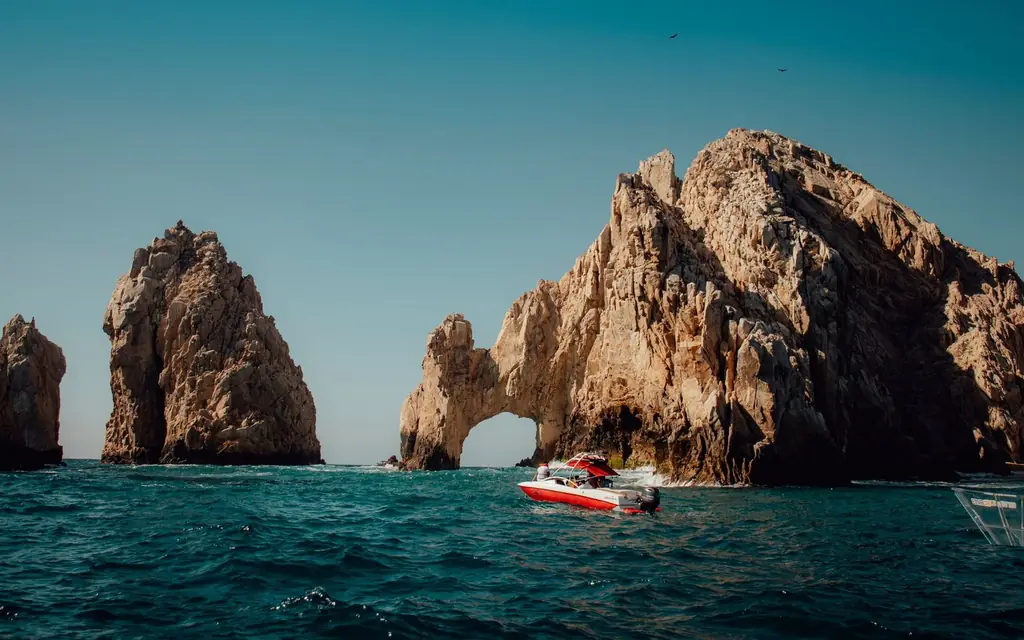
Cabo San Lucas is the busiest part of the coast: marina, restaurants, the bars along the waterfront and, offshore, the rock formation known as El Arco. Cruise ships anchor off the harbour and passengers come ashore by tender, so a ship-day pickup should be checked against the boat schedule. For the broader cruise offer see cruise transfers.
Golf, fishing tournaments and big-event weeks
Los Cabos fills up around golf tournaments, sport-fishing events, weddings and holiday weeks. The practical effect is that vehicles and drivers are scarce on peak days and flights arrive in clusters. Book as early as your dates are certain, and add golf clubs, fishing rods and dive gear to the booking notes so the vehicle matches the load. A Luxury SUV (Cadillac Escalade, GMC Yukon Denali, Chevrolet Suburban or similar) takes up to 6 passengers and 5 to 6 large bags; for a foursome with clubs, a Sprinter is more comfortable.
Weddings and corporate incentives often arrive on several flights over a day. A schedule of staggered pickups can sit on one itinerary, with a coordinator contact and one invoice for the group. See weddings and Sprinter van with driver. Big events may carry a different cancellation deadline, which is printed on the confirmation; for standard bookings the terms are counted from the scheduled pickup, with no charge for changes made more than 72 hours ahead.
Night arrivals, roads and safety
Several airlines land at Los Cabos in the evening, and late arrivals are a good reason to pre-book. The Government of Canada's advice for Mexico says to avoid travelling after dark where possible, to use toll roads and highways and not to run unattended checkpoints. The Transpeninsular Highway between the airport and the corridor is a modern road, but wildlife, cattle and slow vehicles can still appear on the shoulder. A local driver who knows the route is a sensible choice if you land after dark, especially if you are going to a villa in the hills or on the East Cape.
The advice also lists a Canadian consular agency in Cabo San Lucas and a tourist assistance line for Los Cabos; read the full Government of Canada Mexico page before travelling.
Entry paperwork and the time zone
Visitors arriving by air complete Mexico's digital immigration form and keep it as proof of status. The Government of Canada says tourist visas are not required for stays of up to 180 days, and the UK government's entry requirements for Mexico explain how to download digital proof of entry. The Quintana Roo visitor tax applies in Cancun and the Riviera Maya, not in Baja California Sur.
Baja California Sur runs on Pacific time, seven hours behind UTC, all year, since Mexico dropped daylight saving time in 2022. That puts Los Cabos three hours behind Toronto until the clocks change in early November, and two hours behind after that. If you take the red-eye home, work out the pickup time in local time and check it against your itinerary.
Hurricane season and weather
The eastern Pacific hurricane season runs from mid-May to the end of November, and late summer and early autumn are the riskier weeks for Baja. Travel insurance and flexible plans are worth considering. If a storm closes the airport, flight tracking will show your new arrival and the desk can move your pickup.
Vehicles, child seats and private services
Vehicle classes are shown "or similar" and the model is confirmed at booking. The Executive Sedan (Mercedes-Benz E-Class, Cadillac or similar) takes up to 3 passengers; the First Class Sedan (S-Class, BMW 7 Series or similar) takes up to 3; the Luxury SUV takes up to 6; the Executive Sprinter (Mercedes-Benz Sprinter) takes up to 12 passengers and 12 bags. Mini-coaches and coaches of 20 to 56 seats, plus Maybach, Rolls-Royce, stretch limousine and armoured vehicles, are available on request, with availability confirmed at booking. See the fleet page.
Add a child seat at booking; infant, toddler and booster sizes are available. Most vehicles carry water and phone chargers. Our drivers do not photograph clients or post about trips, and a non-disclosure agreement is available on request. For a driver across several days, see personal driver.
For other beach airports, see Cancun, Puerto Vallarta and Punta Cana. The full list is at the resort transfers hub, and the region overview is at Caribbean and Mexico. Travellers starting in Ontario can plan from the Toronto page.
Frequently asked questions
How far is Cabo San Lucas from Los Cabos airport?
About 48 km (30 miles) by road, usually 40 to 55 minutes. San José del Cabo is much closer, at roughly 10 to 15 km (6 to 9 miles) and 15 to 25 minutes. Corridor resorts fall in between, with the time depending on the kilometre marker.
How much is a transfer from Los Cabos airport to the hotel?
It varies by resort, vehicle and time of day. The Onroutz.ca booker shows the fixed all-in fare for your exact pickup, drop-off and vehicle before you pay, and that fare stays the same if traffic is heavy. Taxis agree a fare at the stand, and shuttles charge per seat.
Is there a public bus from Los Cabos airport?
A public bus has been reported to run along the corridor between the airport, San José del Cabo and Cabo San Lucas. It makes many stops and suits a light traveller going to a town centre. With luggage, a connecting leg to your hotel or a late arrival, a private car is simpler.
Which terminal do I arrive at in Los Cabos?
The airport group describes Terminal 2 as international-only and Terminal 1 as handling domestic and some international flights. Your airline decides, and it can change. You do not need to choose, because flight tracking tells the driver which hall you will use.
Is it safe to drive from Los Cabos airport at night?
The Government of Canada advises avoiding travel after dark in Mexico where possible and sticking to toll roads and highways. The airport road is a main highway, but livestock and slow vehicles are possible. If you land after dark, a pre-booked local driver is a calmer way to start.
What time zone is Los Cabos in?
Baja California Sur uses Pacific time (UTC−7) all year, with no daylight saving time. That is three hours behind Toronto until early November, and two hours behind afterwards. Check your flight and pickup times against local time rather than your phone's home setting.
Can I bring golf clubs or fishing gear?
Yes, but tell us when you book. The desk matches the vehicle to the load, and a Sprinter or Luxury SUV is better than a sedan for clubs plus passengers. Boards, rods and dive gear are easier to arrange in advance than on arrival.