 United StatesJFK
 MexicoMEX
 BrazilGRU
 ArgentinaEZE
 ChileSCL
 ColombiaBOG
 PeruLIM
 PanamaPTY
 Costa RicaSJO
 Dominican RepublicPUJ
 JamaicaMBJ
 BahamasNAS
 BarbadosBGI
 United KingdomLHR
 IrelandDUB
 FranceCDG
 GermanyFRA
 NetherlandsAMS
 BelgiumBRU
 SwitzerlandZRH
 AustriaVIE
 ItalyFCO
 SpainMAD
 PortugalLIS
 GreeceATH
 TurkeyIST
 DenmarkCPH
 SwedenARN
 NorwayOSL
 FinlandHEL
 PolandWAW
 Czech RepublicPRG
 HungaryBUD
 IcelandKEF
 United Arab EmiratesDXB
 QatarDOH
 Saudi ArabiaRUH
 IsraelTLV
 EgyptCAI
 MoroccoCMN
 South AfricaJNB
 KenyaNBO
 NigeriaLOS
 IndiaDEL
 PakistanLHE
 Sri LankaCMB
 SingaporeSIN
 MalaysiaKUL
 ThailandBKK
 VietnamSGN
 PhilippinesMNL
 IndonesiaCGK
 Hong KongHKG
 ChinaPVG
 TaiwanTPE
 JapanHND
 South KoreaICN
 AustraliaSYD
 New ZealandAKL
Can you take the Riyadh Metro from the airport to KAFD?
Yes, in principle. The Royal Commission for Riyadh City lists a six-line, 85-station network, with the Yellow Line running 29.5 km along King Khalid International Airport Road and KAFD named as one of four main interchange hubs. Check the operator's journey planner for your terminal's station, then plan for walking at both ends.
Riyadh was long known as a city you could only cross by car. That has changed. The Royal Commission for Riyadh City says the Custodian of the Two Holy Mosques inaugurated the Riyadh Metro Project on 27 November 2024, and that the network spans 176 km across six lines and 85 stations. By mid-2026 the same commission reports that more than 232 million passengers have used it. For a business traveller, that raises a practical question: does it replace the car?
The honest answer is "sometimes". The metro is a good tool for one leg of a trip, and a poor one for a day of back-to-back meetings scattered across a city that spreads for tens of kilometres. This guide separates the cases, using the official network facts as a base, and it is candid about the figures it cannot give: fares, hours and the exact station for your terminal belong to the operator, and they change.
The network in brief
The Royal Commission lists the six lines this way, and the colour names are the ones you will see on signs and maps:
- Blue Line (Line 1): 38 km, from Al-Olaya to Al-Hayer.
- Red Line (Line 2): 25.3 km along King Abdullah Road, with an 8.4 km extension to Diriyah Gate.
- Orange Line (Line 3): 40.7 km, from Al-Madinah Al-Munawarah Road to Prince Saad Bin Abdurrahman I Road.
- Yellow Line (Line 4): 29.5 km along King Khalid International Airport Road.
- Green Line (Line 5): 12.9 km along King Abdulaziz Road.
- Purple Line (Line 6): 29.7 km, between Abdurrahman Bin Awf Road and Sheikh Hassan Bin Hussain Bin Ali Road.
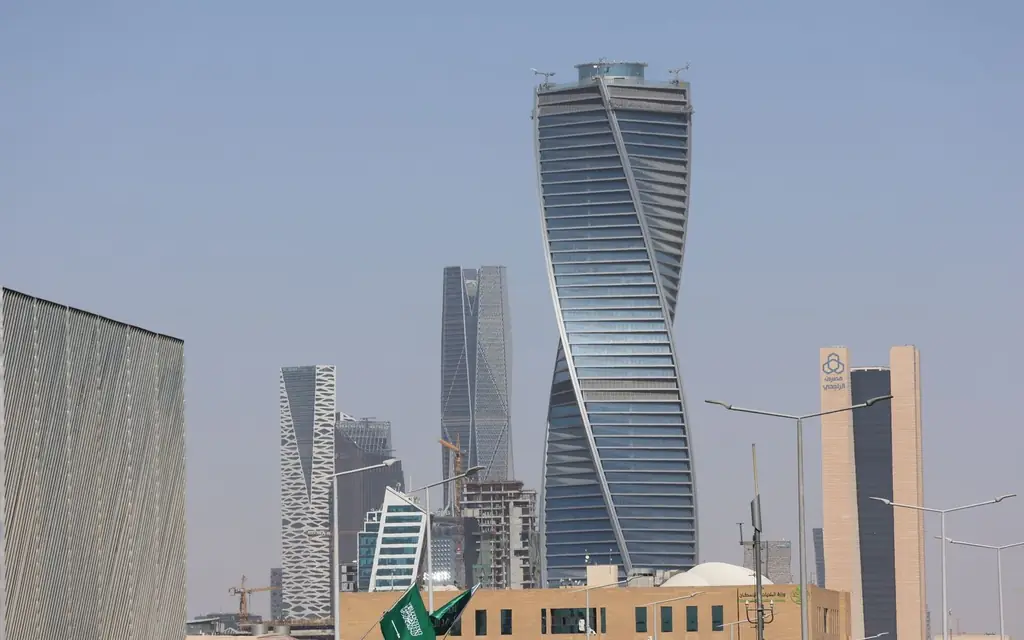
The four main interchange hubs are Qasr Al-Hukm, KAFD, Western and STC-Al-Olaya. KAFD, the King Abdullah Financial District, is the one that matters most to a visiting executive, because it is both a business district and the place where the airport line meets the rest of the network.
The commission page does not say which lines are open and which are still being built, so check the live status before you plan around any one line. The Royal Commission for Riyadh City's metro page and the commission home page are the official sources.
Airport to KAFD: the options side by side
King Khalid International Airport (RUH) is in the north of the city and is run by Riyadh Airports Company, whose official site describes its role in managing and upgrading the airport. The line along the airport road is 29.5 km, and the road distance between the airport and KAFD is similar, about 35 km. A road-network estimate (OSRM, free-flow, no traffic) is roughly 30 minutes, and the morning and late-afternoon peaks take considerably longer.
| Mode | Door-to-door time | Cost note | Luggage | Best for |
|---|---|---|---|---|
| Riyadh Metro, Yellow Line | Use the operator's journey planner and add walking at both ends | Metro fare set by the operator; check before travel | Fine for a carry-on and a laptop bag | A solo traveller with light bags and a flexible start |
| Airport taxi | About 30 minutes without traffic; longer at peaks | Ask whether the fare is metered or posted before you get in | Boot space varies | One traveller who is happy to negotiate on arrival |
| Ride-hail | About 30 minutes without traffic; longer at peaks | App fare, which can rise in busy periods | Varies by vehicle | Short-notice trips within the city |
| Pre-booked car with driver | About 30 minutes without traffic; longer at peaks | Fixed fare via the booker | Sedan, SUV or van sized to the group | Executives, groups, heavy luggage, late arrivals |
We have not given a metro journey time, because the operator's journey planner is the right source. Allow for finding the station in the terminal complex, waiting for a train, riding the line and then walking or taking a short ride from the station. If you are going to a meeting at KAFD itself, the metro's interchange there makes it a good option. If your meeting is in an office tower a kilometre from the nearest station, the walk matters.
When the metro is the better choice
Public transport is the smarter option in four situations.
- You travel light and alone. One carry-on and a laptop bag move easily through a station.
- Your destination is at or beside a station. KAFD, parts of Olaya on the Blue Line and the major hubs are the clearest examples.
- Traffic is bad. On a heavy-traffic day, a train that runs to a timetable beats a car stuck on a ring road.
- You have time to explore. If the first morning is free, a metro ride is a good way to see how the city works now.
In those cases the metro is a good answer, and we would take it ourselves. The system is new, clean and designed for passengers; the airport line is a real asset. A visitor who lands at midday with one bag and a hotel next to a station has no reason to book a car.
When a driver beats metro plus ride-hail
The case for a driver builds with the number of people, bags and meetings.
- Several meetings in a day. A business day in Riyadh can mean a ministry, a bank tower in Olaya, a lunch at KAFD, a site visit and a dinner. Few of those sit beside the same station. Each leg by metro adds a walk, a wait and often a second hop by ride-hail.
- Heat. Riyadh summers are very hot, and even in cooler months the midday sun makes a 15-minute walk in a suit unpleasant. A car delivers you at the door with a jacket still in shape.
- Luggage and equipment. Sample cases, presentation materials and a laptop bag are manageable on a train for one person. For a team of four with suitcases they are not.
- Fixed schedules. A meeting at 14:00 and another at 16:00 on the other side of the city turns the day into a puzzle. A driver on a fixed booking removes the puzzle.
- Late flights. The metro has operating hours. A flight that lands after the last train means a car in any case.
Onroutz.ca delivers Riyadh rides through a vetted, licensed and commercially insured local partner, and the booking, confirmation, invoice and support stay with our Toronto desk. Our King Khalid airport page covers terminals, pickup points and waiting rules, and the executive car service and personal driver pages explain the by-the-hour option.
Five checks before you rely on the metro
- Line status. The commission describes the whole network, but a line described is not always a line running. Confirm on the operator's channels that the Yellow Line and your destination line are open on your travel date.
- The station for your terminal. King Khalid has several terminals. Ask your airline which one you will use and match it to a station in the journey planner.
- Hours on the day you land. A late flight, a Friday or a holiday can change the first and last trains.
- How you pay. Find out whether the operator accepts your bank card or needs an app or stored-value card, and set it up on hotel wifi or before you leave.
- The last mile. Look at the walk from the nearest station to the building on a map. In summer, anything over about ten minutes outdoors deserves a car.
If any of the five comes back uncertain, the car is the safer option for the first day, and you can try the metro once you know the system.
Building a day: three examples
Example 1: light traveller, one meeting at KAFD. Land in the morning, take the metro from the airport to KAFD, walk to the meeting, return the same way. This works because the destination and the station are the same.
Example 2: three meetings across the city. A morning meeting in Olaya, lunch at KAFD, an afternoon session near the diplomatic quarter. Even if each leg has a station, the hops between them will cost more time than they save. A car for the day, or a driver on a half-day booking, lets you spend the time on preparation, not navigation.
Example 3: delegation of four arriving on one flight. The group has suitcases and a presentation case and wants to arrive together at a hotel. A single vehicle meets them at arrivals, carries everything and goes straight to the hotel. The metro could do it, but the cost is the group's time and patience.
Working days, prayer times and the weekend
Saudi Arabia's weekend is Friday and Saturday, and the working week runs Sunday to Thursday. Meetings are arranged around that, and around the five daily prayers, when shops and some businesses pause briefly. Friday midday prayer is observed across the country, and little business takes place in the hours around it. Check your host's availability before you fix times.
During Ramadan the working day shifts, with shorter hours and meetings later in the day; our guide to Ramadan 2027 travel in Dubai and Abu Dhabi explains the pattern, which is similar across the Gulf. Any driver you book should be told the time of your prayer breaks if they matter to you, and your host will usually say.
Jet lag is the other planning issue, especially for travellers from North America who land early in the morning. Our jet lag plan explains how to schedule the first meeting after a long flight.
Visas and entry for business travellers
Most visiting executives from Canada, the United States and the United Kingdom can use the Saudi tourist eVisa for entry: the official Visit Saudi page lists the United States, Canada and the United Kingdom among the eligible countries, with a one-year validity and a stay of 90 days. The page also covers passport validity, age requirements and fees; read the official visa page for the amounts, which we do not quote.
A tourist visa is designed for tourism. If you are travelling for work, confirm with your host which visa category covers the activity, because business visits are handled separately in some cases. Do not assume that a leisure visa covers a meeting schedule.
Meet and greet at King Khalid
Arrivals at a large airport can take time. A driver with a name board in the arrivals hall, or a meet-and-greet agent who walks you through immigration, helps when you arrive late, with a group, or with documents that need attention. The meet and greet hub explains the service; for the wider region, see our Middle East hub.
Frequently asked questions
Is there a metro from King Khalid airport to the city?
Yes. The Royal Commission lists the Yellow Line as running along King Khalid International Airport Road and connecting to the airport. Check the operator for the station that serves your terminal.
Which metro line goes to KAFD?
KAFD is one of four main interchange hubs on the network, and the Yellow Line from the airport links there. Check the live line map for current status.
How long is the drive from the airport to KAFD?
About 35 km. A road-network estimate is roughly 30 minutes without traffic, and it takes considerably longer in the morning and late-afternoon peaks.
Is the Riyadh Metro open on Fridays?
Hours differ by day and line. Because Friday is part of the Saudi weekend, check the operator's timetable rather than assuming weekday hours.
Do Canadians need a visa for Saudi Arabia?
The official Visit Saudi page lists Canada among the countries eligible for the tourist eVisa, valid for one year with stays of up to 90 days. Check the portal for the category that covers your trip.
Can I get a tourist visa for a business meeting?
Do not assume so. The tourist eVisa is designed for tourism. Confirm the right category with your host and the official portal before you travel.
When does a driver make more sense than the metro?
For several meetings in one day, a group with luggage, hot weather, a late flight or a fixed schedule. For one solo trip between two stations, the metro is hard to beat.