 United StatesJFK
 MexicoMEX
 BrazilGRU
 ArgentinaEZE
 ChileSCL
 ColombiaBOG
 PeruLIM
 PanamaPTY
 Costa RicaSJO
 Dominican RepublicPUJ
 JamaicaMBJ
 BahamasNAS
 BarbadosBGI
 United KingdomLHR
 IrelandDUB
 FranceCDG
 GermanyFRA
 NetherlandsAMS
 BelgiumBRU
 SwitzerlandZRH
 AustriaVIE
 ItalyFCO
 SpainMAD
 PortugalLIS
 GreeceATH
 TurkeyIST
 DenmarkCPH
 SwedenARN
 NorwayOSL
 FinlandHEL
 PolandWAW
 Czech RepublicPRG
 HungaryBUD
 IcelandKEF
 United Arab EmiratesDXB
 QatarDOH
 Saudi ArabiaRUH
 IsraelTLV
 EgyptCAI
 MoroccoCMN
 South AfricaJNB
 KenyaNBO
 NigeriaLOS
 IndiaDEL
 PakistanLHE
 Sri LankaCMB
 SingaporeSIN
 MalaysiaKUL
 ThailandBKK
 VietnamSGN
 PhilippinesMNL
 IndonesiaCGK
 Hong KongHKG
 ChinaPVG
 TaiwanTPE
 JapanHND
 South KoreaICN
 AustraliaSYD
 New ZealandAKL
Can you join an Incheon Airport transit tour on a layover?
Yes, if your layover is 24 hours or less and you are a foreign transit passenger. Incheon's own programme page lists three eligible groups: visa-free nationals, third-country transit passengers holding a US, Canadian, Australian, New Zealand or European visa or residence, and general transit passengers. Your passport and both boarding passes are required at the desk. As of October 2026.
That last part is where most plans go wrong. A tour that is advertised as five hours is five hours from the bus leaving the kerb, not from the moment your aircraft touches down. Before the bus there is immigration, a walk to the registration desk and a 30-minute cut-off. After it there is the return drive, a second pass through security and, at Incheon, a possible train ride between buildings.
This guide gives you the arithmetic for a 7 to 10 hour connection, the entry rules that decide whether you can leave at all, and the realistic ways into central Seoul if you would rather design your own few hours than join a group.
What the 24-hour rule and the three eligibility groups mean
The programme page on the Incheon International Airport website sets one hard limit: the layover must be 24 hours or less. If you are staying longer, you cannot join, and you are treated as an ordinary visitor with your own entry requirements.
The three groups it names, in plain terms:
- Visa-free nationals. If your passport allows visa-free entry to Korea, you qualify. The page points to the Korean government's visa portal for the list.
- Third-country transit passengers. If you hold an entry visa or permanent residence for the United States (including Guam and Saipan), Canada, Australia, New Zealand or one of 32 European countries, and you are flying through Korea to or from one of those places, you qualify even if you would otherwise need a Korean visa.
- General transit passengers. Foreign passengers connecting through Incheon who join the programme.
Two details are easy to miss. First, if you are from a visa-free country that is not on the temporary K-ETA exemption list, the page says you must apply for a K-ETA before you can take part. Second, the programme "may change without notice", which is the airport's own wording, so treat any course list as a snapshot.
Do you need a K-ETA for the layover? What the 31 December 2026 date means
The K-ETA is Korea's electronic travel authorisation for visa-free visitors. Korea has been suspending the requirement for a group of countries for limited periods, and the current suspension is dated.
- The Government of Canada's travel advice, updated 21 August 2026, states that Canadians are exempt from the K-ETA requirement until December 31, 2026 and tells readers to check for updates after that date.
- The UK government's advice says British nationals travelling visa-free are temporarily exempt until 31 December 2026 (see its South Korea entry requirements).
- The K-ETA portal's own notice on the temporary exemption gives the period as 1 January to 31 December 2026. It does not list the countries; it says eligible nationals see a "K-ETA exempt" result when they scan their passport in the application, so your own government's travel advice is the quicker check.
The consequence is simple. If your layover happens before the end of December 2026 and your passport is from an exempt country, you do not apply for a K-ETA. If you are flying in 2027, do not assume the exemption has been renewed. The K-ETA portal carries a March 2026 notice about the exemption period, and the safest habit is to read the notice board for your travel date rather than trust a blog post, including this one.
If your country is not exempt, apply before you fly rather than at the desk.
Which transit tour courses exist, and what do they really take?
The airport's course page lists 12 options. They are not all free and not all the same length, which surprises people who arrive expecting one standard bus tour. These are the ones most relevant to a short connection, taken from the listing as of October 2026:
| Course | Length | Cost listed | Listed hours and days |
|---|---|---|---|
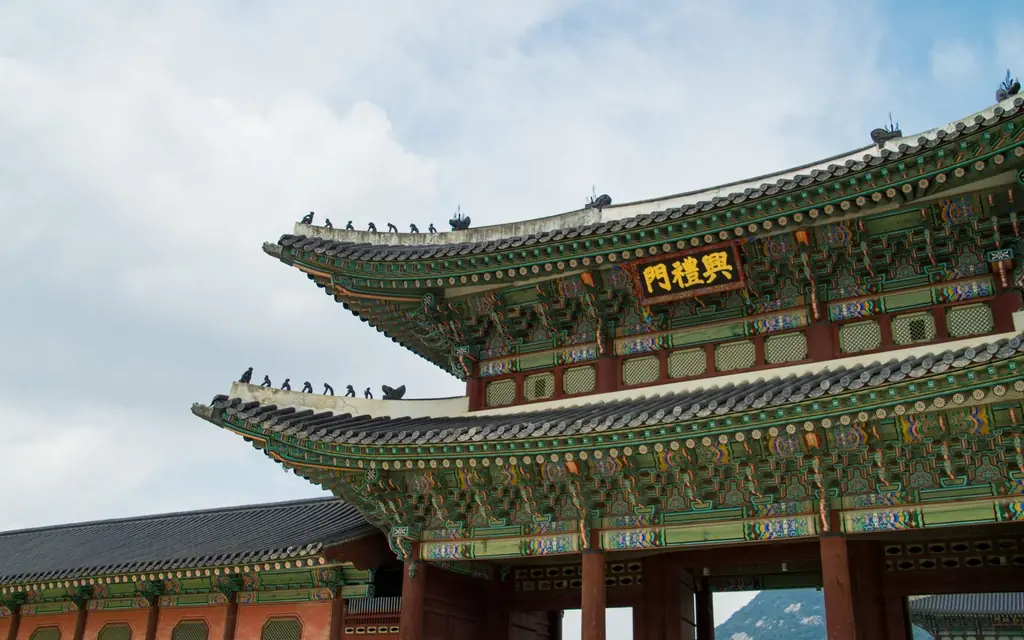
| Royal Heritage and Charm (Gyeongbokgung, Insadong) | 5 h | US$3 | 09:00–14:00, Tue–Sun |
| Trendy Hub of Youth (Hongdae) | 4 h | Free | 14:00–18:00, Mon, Tue, Sat, Sun |
| Petit Shopping Delight (Sinpo Market) | 3 h | Free | 15:00–18:00, daily |
| Fun with the Seagulls (Wolmi Park, ferry) | 4 h | Free | 09:00–13:00, Tue, Sat, Sun |
| DMZ Tour (Third Tunnel, Dora Observatory) | 5 h | US$4 | 09:00–14:00, Thursday |
| K-Culture Zone (inside Terminal 1 transit lounge) | 30 min | Free | 09:00–20:00 |
Two courses involve the Korean border area and run on fixed weekdays, so they only work if your layover happens to fall on those days. The K-Culture Zone is the only option that never leaves the airport, which makes it the sensible choice when the numbers do not add up.
What is the minimum layover for a transit tour?
The airport page lists no minimum connection time. The 24-hour ceiling is the only number it states. Airlines promoting the programme have quoted floors of around four hours, but those are marketing summaries and I could not find the figure on the airport's own page, so I am not treating any of them as a rule.
Work backwards from the course instead. For the 5-hour Gyeongbokgung course, count:
- Arrival to the registration desk: immigration, then a walk, plus the shuttle train if you landed at the Concourse (our planning allowance, not an airport figure: 45 to 75 minutes on a busy morning).
- The 30-minute cut-off before the tour leaves.
- Five hours of tour.
- Return, re-check-in and security for your next flight: at least two hours for an international departure.
That is roughly eight and a half hours before the departure time of your next flight, and it ignores any delay. A 7-hour layover fits the 3-hour Sinpo Market course comfortably and the 5-hour palace course only if everything runs on time. For anything shorter than about six hours, the K-Culture Zone or a meal inside the airport is the honest answer.
How do you register, and where is the desk?
The programme page gives the registration steps:
- Online reservation is available, but walk-in registration on arrival is also accepted, first come, first served.
- Bring your passport and the boarding passes for your arriving and departing flights.
- Reach the registration desk at least 30 minutes before the tour starts. Reservations expire 30 minutes before departure and the seats go to the waiting list.
- If you arrive at the Concourse, take the underground shuttle train to Terminal 1 or Terminal 2 first, then go to the registration desk on the first floor.
- Terminal 1: after immigration, near exits 1 and 2 (desks 19 and 20).
- Terminal 2: first floor, across from exit 4 (desks 5 and 6).
Leave your checked bags tagged through to your final destination and carry only what you need for the day.
How do you get from Incheon Airport to central Seoul?
Central Seoul is about 55 km by road from Terminal 1, roughly 55 minutes without traffic (OpenStreetMap road-routing data, free-flow), depending on where in the city you are going. These are the standard modes, using figures published by the operators and by Korea's tourism bodies:
| Mode | Door-to-door time | Cost note | Luggage | Best for |
|---|---|---|---|---|
| AREX Express train | 43 min from T1, 51 min from T2 to Seoul Station | Fare shown at booking | Racks near doors | Solo traveller, Seoul Station area |
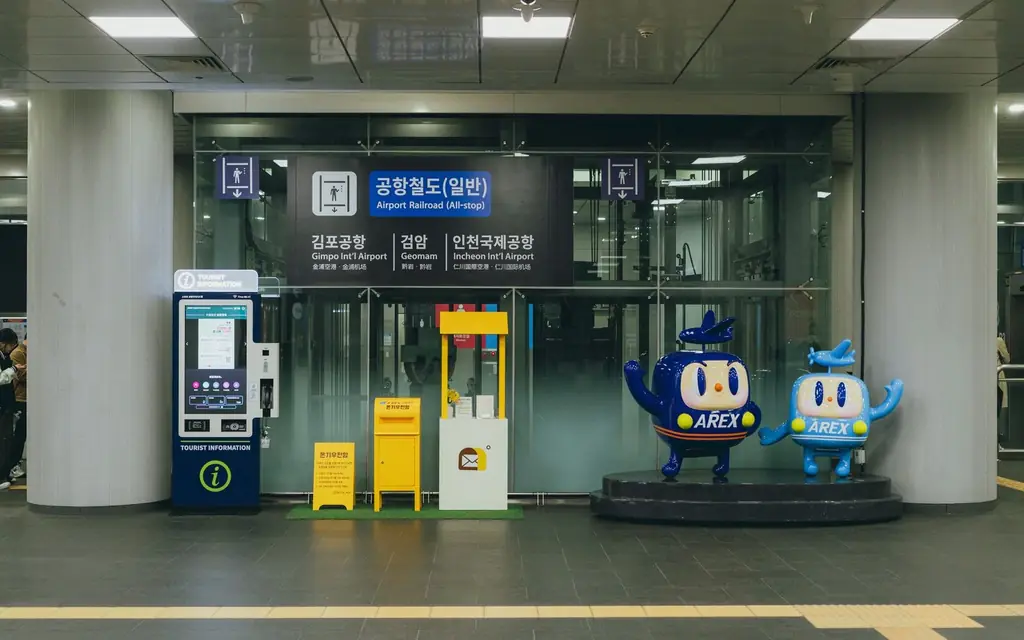
| AREX all-stop train | Just under 60 min to Seoul Station | 4,150 to 4,750 won, depending on the station | Limited | Budget, flexible stops |
| Airport limousine bus | 60–80 min, traffic-dependent | Fare paid at the ticket desk | Under-bus hold | Hotels on bus routes |
| Standard taxi | About 55 min without traffic; longer at peak | Metered, plus expressway toll | Boot | Small groups |
| Pre-booked private car | About 55 min without traffic; longer at peak | Fixed fare via the booker | Full boot, SUV or van | 3+ travellers, heavy luggage |
The express train times come from AREX, and the all-stop, bus and fare figures from Visit Seoul's getting-to-Seoul page. Express fares are not quoted here because the figures on the operator's own pages do not agree with each other, so check the booking page the day you fly.
When AREX is the better choice
If you are alone, travelling light and heading to the Seoul Station area, the AREX Express wins. It is predictable, it does not care about the Yeongjong bridge traffic, and a 43-minute ride from Terminal 1 gives you more time in the city than any road option can. If you may land after the last train, check the AREX timetable for the final departure before you plan around it.
The all-stop train is slower but calls at Hongik University, which suits a Hongdae afternoon.
When a car beats the train from Incheon
A car earns its place in three situations on this route.
- A group of three or more, where one vehicle with a boot replaces three train fares and a station transfer with bags.
- A short window with fixed commitments, such as a business lunch in Gangnam where a missed connection on the Seoul metro costs you the meeting.
- A late or early flight outside train hours, or an arrival with children and a stroller where stairs at the other end are the real obstacle.
On the road side, Seoul traffic is the variable. The free-flow figure above is a best case and a weekday evening will run longer, which is why a driver who tracks your flight and your timings is more useful than the vehicle itself. The Incheon Airport to Seoul transfer page sets out the route, and the private transfer service explains how a pre-booked car works across Asia.
A realistic plan for a 7 to 10 hour Incheon layover
Assume you land at 09:30 and fly at 19:30, a 10-hour gap, and you are on an exempt passport.
- 09:30 landing, 10:15 through immigration with only hand baggage.
- 10:30 AREX Express from Terminal 1, arriving at Seoul Station about 11:15 (the express runs from Terminal 1 in 43 minutes).
- 11:30 to 15:30 in the city, with a hard stop.
- 15:45 back on the train, 16:30 at the airport.
- 17:00 through check-in and security, which leaves two and a half hours as a margin.
Shorten that by two hours and you have a lunch near Seoul Station and nothing more ambitious. Shorten it by four and you stay airside.
If you are connecting on separate tickets, double the margin. The post on whether a one-hour layover is enough explains why a single ticket protects you and two bookings do not. For other Asian hub options, compare the Changi layover guide and the Haneda layover guide.
Mistakes travellers make with Korean layovers
- Assuming the K-ETA exemption continues. It is dated, and the date is 31 December 2026.
- Leaving checked bags unchecked through. Confirm they are tagged to your final airport.
- Choosing the DMZ tour on the wrong weekday. The listed schedule has it on Thursdays only.
- Treating the tour as door to door. The tour starts at the kerb after you clear immigration, not at landing.
- Forgetting Seoul rush hour. A free-flow drive of about 55 minutes is not a 55-minute drive at 17:30.
For planning anything longer than a day trip, the Asia-Pacific hub lists the airports and routes Onroutz.ca covers across the region, and the airport transfers hub shows the same structure for the rest of the world.
Frequently asked questions
Is the Incheon transit tour free?
Some courses are free and some are not. As of October 2026 the airport lists several courses at no charge, a few at US$3 or US$4, and two golf courses at a fixed won price. Check the course page on the airport website before you rely on a free tour.
How long a layover do you need to leave Incheon Airport?
The airport states only a ceiling of 24 hours. Practically, a 3-hour course needs about seven hours between flights once immigration, the 30-minute cut-off and a two-hour pre-departure buffer are counted, and a 5-hour course needs closer to nine.
Do I need a K-ETA to transit through Incheon?
If you stay airside on a single ticket, you do not enter Korea. If you leave the airport on a transit tour, K-ETA rules apply to your nationality. Canadian and British passport holders are exempt until 31 December 2026, per their governments' advice. Check the K-ETA notice board for dates after that.
How early must I be at the registration desk?
At least 30 minutes before the tour starts. Reservations expire 30 minutes before departure, and unclaimed seats go to the waiting list, so a late arrival loses the place even if you booked online.
How long does AREX take from Incheon Airport to Seoul?
The AREX Express takes about 43 minutes from Terminal 1 and 51 minutes from Terminal 2 to Seoul Station, according to the operator. The all-stop train takes just under 60 minutes to Seoul Station, according to Visit Seoul.
Can I book a car for the airport-to-Seoul leg?
Yes. A pre-booked private car with flight tracking and a driver at arrivals covers the Incheon to Seoul leg, and the booker shows the fixed all-in fare for your exact pickup, drop-off and vehicle before you pay.
Is it worth leaving the airport on a 6-hour layover?
Usually not for a city tour, because the arithmetic leaves under two hours in the city. A 3-hour course such as Sinpo Market, or the in-terminal K-Culture Zone, fits better. At eight hours and above, a train into Seoul Station becomes realistic.