 United StatesJFK
 MexicoMEX
 BrazilGRU
 ArgentinaEZE
 ChileSCL
 ColombiaBOG
 PeruLIM
 PanamaPTY
 Costa RicaSJO
 Dominican RepublicPUJ
 JamaicaMBJ
 BahamasNAS
 BarbadosBGI
 United KingdomLHR
 IrelandDUB
 FranceCDG
 GermanyFRA
 NetherlandsAMS
 BelgiumBRU
 SwitzerlandZRH
 AustriaVIE
 ItalyFCO
 SpainMAD
 PortugalLIS
 GreeceATH
 TurkeyIST
 DenmarkCPH
 SwedenARN
 NorwayOSL
 FinlandHEL
 PolandWAW
 Czech RepublicPRG
 HungaryBUD
 IcelandKEF
 United Arab EmiratesDXB
 QatarDOH
 Saudi ArabiaRUH
 IsraelTLV
 EgyptCAI
 MoroccoCMN
 South AfricaJNB
 KenyaNBO
 NigeriaLOS
 IndiaDEL
 PakistanLHE
 Sri LankaCMB
 SingaporeSIN
 MalaysiaKUL
 ThailandBKK
 VietnamSGN
 PhilippinesMNL
 IndonesiaCGK
 Hong KongHKG
 ChinaPVG
 TaiwanTPE
 JapanHND
 South KoreaICN
 AustraliaSYD
 New ZealandAKL
Is it better to start an Alaska cruise from Vancouver or Seattle?
Choose Vancouver for one-way itineraries and a longer season of departures. Choose Seattle for round trips with a US airport and no border crossing on the way in. US law keeps most large foreign-flagged ships from carrying passengers one-way between two US ports, which is why one-way Alaska voyages start in Canada.
The choice looks like a matter of taste. It is really a matter of three things: how you want the cruise to end, which country you are flying into, and what your passport allows. Both cities are major cruise ports with good airports and large Alaska programmes. They differ in the law that shapes their itineraries and in the road between them.
This guide explains the rule that creates the difference, then sets the two ports side by side, covers documents and the border, and finishes with the airport transfers, including the 230 km drive between the two cities for travellers who fly into one and sail from the other.
The rule behind the difference: the Passenger Vessel Services Act
The US Passenger Vessel Services Act stops a vessel from carrying passengers between two US ports unless it is US-built, US-flagged and US-owned. Nearly all large cruise ships are foreign-flagged, so they fall under it. US Customs and Border Protection summarises the effect in its informed-compliance guide: foreign vessels may embark passengers at a US point for disembarkation at a foreign port, and the reverse, but may not transport passengers between US ports, directly or via a foreign port.
CBP's guide is specific about the "foreign port" part. A nearby foreign port, meaning one in North America, Central America, the Bermuda Islands or the West Indies, does not rescue a one-way voyage between two US ports. Its own example is a voyage from Los Angeles to Hawaii and Ensenada, Mexico, then to San Diego, which breaks the rule because Ensenada is a nearby foreign port. Only a distant foreign port can do that, and Canada is not one.
That is the whole reason for the pattern you see on the brochures:
- Vancouver to Whittier or Seward (or the reverse). One end is foreign, so a foreign-flagged ship may carry you one-way. This is the classic northbound or southbound Alaska cruise.
- Seattle round trip. You embark and disembark at the same US port, so the rule is not triggered.
- Seattle to Alaska, one-way. Both ends are US ports, so a large foreign-flagged ship cannot sell it.
The CBP document is a 2019 revision, and the law's detail can change, so read the CBP guidance on the Passenger Vessel Services Act for the wording. For your own booking, your cruise line has already structured the itinerary to comply.
Vancouver and Seattle side by side
| Factor | Vancouver, Canada Place | Seattle, Pier 91 and Pier 66 |
|---|---|---|
| Voyage types | Round trips and one-way voyages to or from Alaska | Round trips |
| Typical Alaska season | Seasonal; check your cruise line's sailing dates | The port's fact sheet describes the 2026 Alaska season as May through October |
| Airport | Vancouver International (YVR), about 17 km from the pier | Seattle-Tacoma International (SEA); the port notes that 82 percent of cruise guests arrive by air |
| Border | You enter Canada to board | No border to board; a Canadian port call is usual |
| Terminal setting | Beside Canada Place, a short walk from Waterfront Station | Pier 91 at Smith Cove (two berths) and Pier 66 on the downtown waterfront (one berth) |
| Best for | One-way trips, travellers flying from Canada, a Whistler add-on | US residents, short flights, round-trip itineraries |
The Port of Seattle's 2026 fact sheet says the season brought 15 cruise lines and 26 ships to Seattle's terminals, with 330 port calls and more than two million cruise visitors, and says Pier 91 is about 10 minutes from the city's retail core while Pier 66 is within walking distance of Pike Place Market. Read the Port of Seattle cruise fact sheet for the port's own figures.
Passports and documents: what to carry
Documents matter more than most travellers expect, because an Alaska cruise leaves and enters two countries.
CBP's notice to Seattle cruise passengers explains that cruises arriving from foreign countries must meet the Western Hemisphere Travel Initiative and that almost all Alaska cruises stop in Victoria, Canada, which counts as foreign travel. For adult US and Canadian citizens it lists a government-issued photo ID plus proof of citizenship, or a passport or other WHTI-compliant document. On closed-loop cruises, which start and end at the same US port, US citizens may re-enter with a birth certificate and government photo ID. Children aged 16 and under need proof of citizenship, such as a birth certificate. Verbal claims are not accepted. The notice dates from August 2019 and CBP flags it as archived, so check CBP.gov for the current wording.
The cautious answer is the simple one: carry a passport. There are four reasons.
- Flying. If you fly to Vancouver or home from it, you need a passport on the aircraft in any case.
- Canada. Entry rules for Canada apply at Canadian ports of call. Visa-exempt foreign nationals who fly to Canada need an electronic travel authorization; our guide to who needs a Canadian eTA explains.
- Emergencies. If you must leave the ship in a foreign port, a passport solves the problem.
- Cruise line policy. Many lines ask for passports from all passengers on Alaska itineraries.
Foreign nationals visiting the United States should also check US entry rules, including the visa-waiver authorization where it applies. Our ESTA guide for UK travellers covers one common case.
From the airport to Canada Place
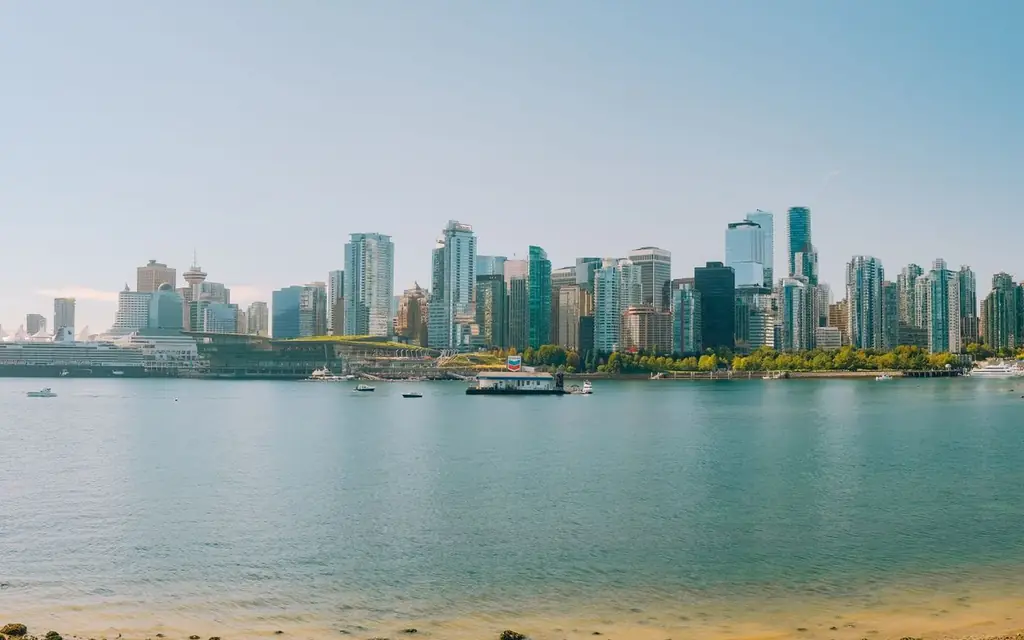
Vancouver International is about 17 km (11 mi) from Canada Place by road, roughly 30 minutes without traffic by road-network estimate (OSRM) and longer at weekday peaks. The Canada Line from YVR reaches Waterfront Station in 26 minutes according to Tourism Vancouver, and the terminal is a short walk. TransLink lists the first train from YVR toward Waterfront at 5:09 am and the last at 12:54 am, with trains every 6 to 15 minutes depending on the time of day. Check TransLink's SkyTrain schedules before you rely on them, and note that trips leaving YVR carry an extra airport fare.
| Mode | Door-to-door time | Cost note | Luggage | Best for |
|---|---|---|---|---|
| Canada Line plus walk | 26 minutes on the train plus the walk and the wait | Transit fare plus the airport surcharge | A cruise suitcase or two is hard on stairs and platforms | One or two passengers with a light cabin bag |
| Taxi | About 30 minutes without traffic | Metered or zone-based | Boot space varies | Two passengers, normal luggage |
| Pre-booked private car | About 30 minutes without traffic; longer at peaks | Fixed fare via the booker | Sedan, SUV or van | Families, groups, large cruise luggage, tight embarkation |
Cruise luggage is the deciding factor. Two large cases per person, a carry-on and a family of four do not go well on a train and a walk of several blocks. Our Vancouver airport page explains terminals and pickup points, and the Canada hub shows where else we operate in the country.
From Sea-Tac to the Seattle piers
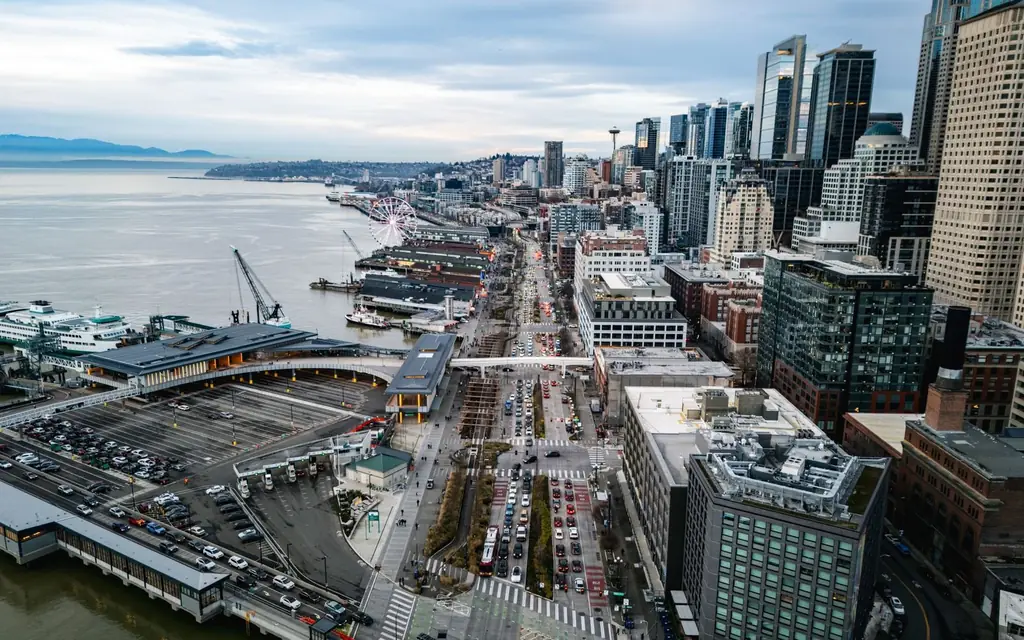
Seattle's two cruise terminals sit in different parts of the waterfront, and your cruise documents say which you use. The Port of Seattle describes Pier 91 as having a dedicated app-based rideshare lot, taxis, airport shuttles, a private-vehicle drop-off area and bus parking, and Pier 66 as having ground transportation at the entrance, with bus parking, taxis, airport shuttles, private-vehicle drop-off and a rideshare zone.
Sea-Tac is on the south side of the city, and the drive is about 25 km (15 mi) to Pier 66 and about 30 km (19 mi) to Pier 91, roughly 25 to 35 minutes without traffic by road-network estimate, and longer around the Alaska season's busy weekends. Our Seattle cruise transfers page covers the process, and the companion guide to Pier 91 versus Pier 66 explains the terminals in detail.
The road between the two cities
Some travellers fly into one city and sail from the other, usually because fares are better to one airport or because the cruise is a Vancouver one-way. The distance between downtown Seattle and downtown Vancouver is roughly 230 km (142 mi). A road-network estimate is about 3 hours without traffic or a border queue, and the border can add a good deal more.
The border is the variable. The CBSA publishes estimated waits for travellers entering Canada. When we checked on 10 October 2026, with the page updated at 15:20 Pacific time, Douglas (Peace Arch) showed 5 minutes, Pacific Highway 10 minutes and Abbotsford-Huntingdon 5 minutes. That is one quiet autumn afternoon; a summer weekend can be far longer. See the CBSA border wait times and our guide to border wait times and passports.
A through-car is useful when you have luggage or when a ship is waiting. Cruise embarkation does not move for a late border queue, so aim to reach Vancouver the day before. For Vancouver and Seattle, rides are delivered by vetted local partners and booked, supported and invoiced by the Onroutz.ca desk in Toronto; say at booking that the trip crosses the border so that it can be confirmed as covered.
Embarkation day: when to reach the pier
Cruise lines publish a boarding window on your documents, and the ship leaves on a fixed schedule, so the day is built from the sailing time backwards. If the ship sails at 16:00, boarding commonly closes well before that, and the terminal works through guests in the hours leading up to it. Aim to arrive inside your window, not at the start of it, because early arrivals queue.
The safest habit is to spend the night before in the departure city. A flight that lands at noon on sailing day leaves a small margin for a delayed aircraft, a slow border line and a long luggage wait. A hotel night in Vancouver or Seattle costs less than a missed ship. If you must fly the same day, book the earliest flight and keep the rest of the morning free.
On disembarkation, the ship arrives early and guests leave in groups by deck. Book flights for the afternoon, not the morning, unless the cruise line gives an explicit guide.
Adding Whistler before or after
Vancouver is also the gateway to Whistler. A road-network estimate puts Whistler about 135 km (85 mi) from YVR, roughly 2 hours 25 minutes by road on Highway 99 without traffic. Many passengers spend a night or two there before a May or June sailing. Our page for Vancouver airport to Whistler covers the route. Leave plenty of time if you are connecting to a cruise the same day, and avoid cutting the schedule close: Highway 99 is a mountain road, and a single incident can close it.
Choosing: a short decision guide
- You want a one-way Alaska voyage: Vancouver.
- You live in the US and prefer a short flight and no border to board: Seattle.
- You are flying from Canada: Vancouver, unless fares point elsewhere.
- You want a Whistler stay: Vancouver.
- You want a round trip with the fewest moving parts: either, depending on your airport.
- Your party is large or the luggage heavy: budget for a car at either end.
Frequently asked questions
Why do one-way Alaska cruises start in Vancouver?
Because the US Passenger Vessel Services Act stops large foreign-flagged ships from carrying passengers between two US ports. A voyage that starts in Vancouver and ends in Alaska has a foreign end, so it is allowed.
Can I sail one-way from Seattle to Alaska?
Not on most large foreign-flagged ships. Seattle round trips are available, and they usually include a Canadian port call such as Victoria.
Do I need a passport for an Alaska cruise?
Carry one. CBP's closed-loop rule lets US citizens return with a birth certificate and photo ID, but you may need a passport to fly, to enter Canada and to handle emergencies, and many lines ask for them.
How far is Vancouver airport from Canada Place?
About 17 km (11 mi). A car takes roughly 30 minutes without traffic, and the Canada Line takes 26 minutes to Waterfront Station according to Tourism Vancouver, plus a short walk.
How far is Seattle from Vancouver?
Roughly 230 km (142 mi). Allow about 3 hours without traffic or a border queue, and more with one.
Which Seattle terminal will my ship use?
Your cruise documents say. Pier 91 at Smith Cove has two berths, and Pier 66 on the downtown waterfront has one.
How far is Whistler from Vancouver airport?
About 135 km (85 mi), roughly 2 hours 25 minutes by road without traffic, by road-network estimate.