 United StatesJFK
 MexicoMEX
 BrazilGRU
 ArgentinaEZE
 ChileSCL
 ColombiaBOG
 PeruLIM
 PanamaPTY
 Costa RicaSJO
 Dominican RepublicPUJ
 JamaicaMBJ
 BahamasNAS
 BarbadosBGI
 United KingdomLHR
 IrelandDUB
 FranceCDG
 GermanyFRA
 NetherlandsAMS
 BelgiumBRU
 SwitzerlandZRH
 AustriaVIE
 ItalyFCO
 SpainMAD
 PortugalLIS
 GreeceATH
 TurkeyIST
 DenmarkCPH
 SwedenARN
 NorwayOSL
 FinlandHEL
 PolandWAW
 Czech RepublicPRG
 HungaryBUD
 IcelandKEF
 United Arab EmiratesDXB
 QatarDOH
 Saudi ArabiaRUH
 IsraelTLV
 EgyptCAI
 MoroccoCMN
 South AfricaJNB
 KenyaNBO
 NigeriaLOS
 IndiaDEL
 PakistanLHE
 Sri LankaCMB
 SingaporeSIN
 MalaysiaKUL
 ThailandBKK
 VietnamSGN
 PhilippinesMNL
 IndonesiaCGK
 Hong KongHKG
 ChinaPVG
 TaiwanTPE
 JapanHND
 South KoreaICN
 AustraliaSYD
 New ZealandAKL
When is the best time to visit Punta Cana?
December to April is the best time to visit Punta Cana for dry, settled weather, and it carries the highest prices. May to early July and late September to October bring cheaper rooms, short heavy showers and a higher chance of seaweed. Hurricane season runs 1 June to 30 November, with most activity between mid-August and mid-October.
Punta Cana's brochure image is a single bright week repeated twelve times. The real calendar has three seasons: a dry high season with the best weather and the biggest bills, a hot and showery middle of the year when value is easy to find, and a late-summer and autumn stretch when the Atlantic storm season peaks. Add sargassum, which did not respect any calendar in 2026, and the choice is no longer simply "winter or summer".
This guide goes through each piece with the sources we could check, flags where travel guides disagree, and finishes with the part most planners skip: the road between the airport and your resort.
The three seasons in plain terms
High season, December to April. Travel guides consistently describe this as the driest, calmest and busiest period, with the year's highest rates. January to March are usually named as the driest months. Whale watching in Samaná Bay, on another part of the island's coast, peaks from January to March.
The long middle, May to early July. Warm, mostly sunny and humid, with brief showers. Prices fall well below winter levels. This is the window that rewards travellers who can accept a little weather risk.
Storm season, mid-August to mid-October. The U.S. National Hurricane Center states that the Atlantic hurricane season runs from 1 June to 30 November, with the peak on 10 September and most activity between mid-August and mid-October. Guides argue that Punta Cana is off the busiest paths, on the Atlantic side of the island, and put the odds of a serious hit in any given trip at low. That is reassuring but not a guarantee, so insurance and flexible bookings are sensible.
What the rainy season is actually like
The phrase "rainy season" frightens people who picture a week of grey. Travel guides describe the pattern differently: a couple of heavy showers a day, each lasting roughly 10 to 20 minutes, with full days of rain uncommon. The sun comes back, the pool is empty for twenty minutes, and the lobby bar does well.
Three things make the difference between a good and a poor rainy-season trip.
- Pick a resort with indoor options. Spas, restaurants and show lounges save wet afternoons.
- Book excursions flexibly. Boat trips and catamaran days can cancel in rough seas, and some operators allow free rebooking.
- Watch the tropical forecast, not the daily one. A tropical wave still days away tells you more about next week than a single-day icon.
Sargassum: the 2026 problem
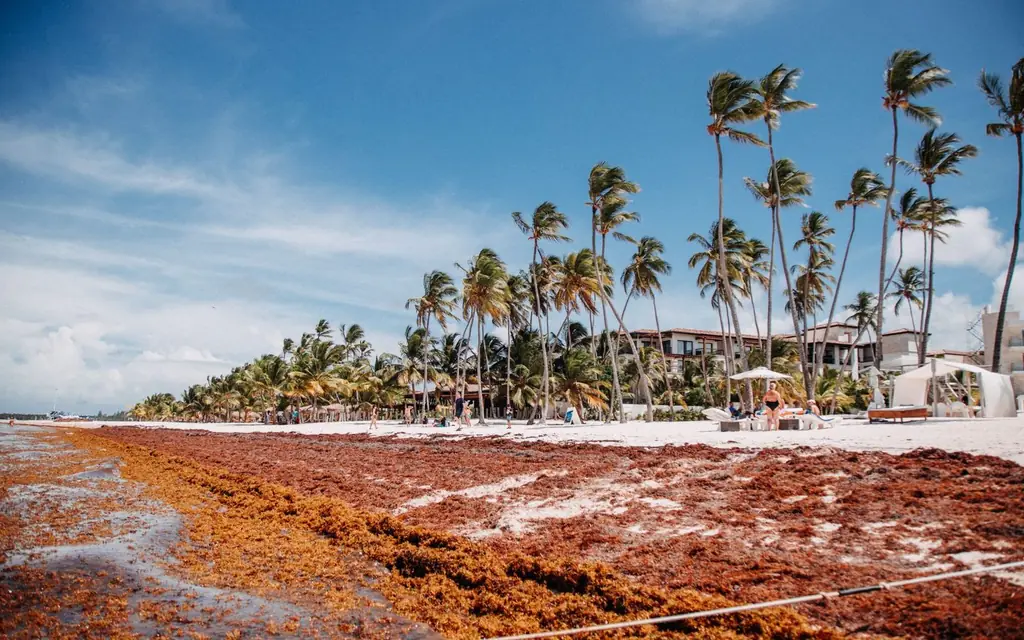
Seaweed is the planning variable that changed most this year. The University of South Florida's satellite work, reported by Dominican Today on 9 July 2026, counted about 9 million metric tons of sargassum across the region between January and 30 June 2026. That compares with 8.3 million tons over the same months of 2025 and 1.2 million in 2024. The report names Punta Cana and Bávaro, says hotels and private businesses clear beaches daily with heavy equipment and manual labour, and says public beach areas often cannot keep up. Tour operators in Bávaro told the paper that the look and smell of the weed were putting visitors off.
What that means for planning:
- Expect variation by resort. Beaches in front of large resorts are raked and cleaned more consistently than public stretches.
- East-facing beaches get the most. Seaweed arrives with Atlantic currents and trade winds from the east. One resort operator named Bávaro Beach and Arena Gorda among the worst affected stretches in 2026; treat that as one view rather than measured data.
- Do not assume a month is safe. The traditional pattern put the heaviest arrivals in spring and summer, and 2026 broke patterns across the Caribbean.
- Use live data. The USF Sargassum Watch System publishes daily satellite maps and monthly outlook bulletins for the Caribbean and Gulf of Mexico. Check the outlook in the month you fly.
Our companion piece on the best time to visit Cancún shows how Mexico's authorities handle the same problem a few hundred kilometres west.
Month by month
| Months | Weather | Storm risk | Seaweed | Prices and crowds |
|---|---|---|---|---|
| December | Dry, warm | Season ends 30 Nov | Variable; check outlook | Climbs to Christmas peak |
| January to March | Driest months | Very low | Variable | High; Ontario's March Break and U.S. spring breaks add pressure |
| April | Dry, warming | Low | Variable | Easter spike, then falls |
| May to June | Hot, short showers | Season opens 1 June | Often higher | Good value |
| July to August | Hot, humid | Rising from mid-August | Historically a heavy period | Summer family travel |
| September to mid-October | Wet, hot | Peak around 10 September | Variable | Lowest prices; flexible tickets advised |
| Late October to November | Drying out | Season ends 30 Nov | Lower in some years | Quiet before Christmas |
Treat this as a pattern guide rather than a forecast. Winters and summers differ from year to year, and the table is not a substitute for a forecast one week out.
Peak-price weeks for Canadian and American travellers
For travellers from Canada and the United States the expensive weeks are predictable.
- Christmas to New Year. The tightest availability of the year. Book far ahead.
- Mid-February holiday weeks. Long weekends and school breaks in the United States and Canada push demand up.
- March Break and spring break. Ontario's March Break falls in mid-March, and U.S. spring breaks run through March.
- Easter. The date moves, and the week around it is dear. In 2027 Easter is on 28 March, so it merges with the March peak.
If your dates are flexible, early December, the second half of January, late April and May are the strongest value windows. If they are not, book early and treat flights, resort rates and transfers as one budget rather than three.
Entry rules and documents
The Dominican Republic runs an electronic ticket process for arrivals. Our guide to the Dominican Republic e-ticket explains who completes it and when. Check the Dominican government's official pages and your airline for the current requirement before you fly, as these processes change. For a wider destination overview the national tourism site is godominicanrepublic.com.
From the airport to the resort: drive times
Punta Cana International Airport (PUJ) has two terminals, Terminal A and Terminal B. Its site lists Uber pick-up areas at both and refers to authorised taxis. Resorts are spread along a coastal strip with a single main road, the Boulevard Turístico del Este, so the time you spend in the car depends on where you are staying and on whether that road is clear.
| Resort area | Approx. distance from PUJ | Drive without traffic | Best for |
|---|---|---|---|
| Cap Cana | About 17 km (10 mi) | Roughly 20 min | Golf, marina, gated resorts |
| Bávaro | About 20 km (14 mi) | Roughly 25 min | Main cluster of all-inclusives |
| Macao | About 30 km (20 mi) | Roughly 30 min | Quieter beach, smaller crowds |
| Uvero Alto | About 40 km (25 mi) | Roughly 45 min | Remote, upscale resorts |
Those figures are OSRM road routing to a central point in each area, rounded, and they vary with the day, the hour and what is happening on the highway. A blocked road at Bávaro adds a long delay because there is no parallel route. For a late-evening arrival with children, the 25 minutes to Bávaro and the 45 minutes or more to Uvero Alto are very different trips.
How the options compare:
| Mode | Door-to-door time | Cost note | Best for |
|---|---|---|---|
| Pre-booked private car | As above, plus a short wait at arrivals | Fixed fare via booker | Families, late flights, groups |
| Authorised airport taxi | As above, plus the queue | Fare agreed under airport rules; confirm before you ride | Walk-up arrivals |
| Ride-hailing | As above, plus the wait for a match | Demand-priced | Light packers, off-peak |
| Resort shuttle | Longer, multiple drops | Resort-set fare | Packages that include transfers |
We cover the resort drives in detail on our Punta Cana resort transfer page and the Punta Cana resort hotel transfers page, and every other Caribbean gateway we serve is listed under the Caribbean and Mexico hub and the resort transfers hub.
Which month for which trip?
- A honeymoon or anniversary: January to March for the driest weather; accept the price.
- Young children: May, early June or early December, when the heat is manageable and the resort is not full.
- Bargain hunters: September and early October, with flexible tickets and a resort that has indoor facilities.
- People who hate seaweed: no month is guaranteed. Pick a resort with a cleaning record, check the outlook and have a pool plan.
- Travellers connecting from St Lucia or other islands: see our guide to the best time to visit St Lucia for a comparison of Caribbean seasons.
Arrival-day details that help
Tell the driver your flight number and your resort's full name. Flight tracking means a late landing is handled for you. An arrivals name board helps after dark, and a booster seat for a child is one of the options at booking.
Because the Boulevard Turístico del Este is the single main road, tell the driver your resort's exact name, not just "Bávaro". The coast has many large resorts with similar names.
Frequently asked questions
What is the cheapest month to visit Punta Cana?
Prices are generally lowest from September to mid-October, when the hurricane season peaks and demand falls. May to early July are also good value. In return you accept more rain, more heat and a higher chance of storms or seaweed. Buy flexible tickets and insurance.
Is Punta Cana safe in hurricane season?
Most guides say that Punta Cana is on the Atlantic side of the island, off the main hurricane paths, so serious hits are uncommon. The season runs 1 June to 30 November, with most activity from mid-August to mid-October. Travel insurance and flexible fares are sensible.
Does it rain all day in the rainy season?
Rarely. Travel guides describe a couple of heavy showers a day, usually lasting 10 to 20 minutes, with sun in between. Full days of rain are uncommon, though a tropical system can bring several wet days together.
How bad was sargassum in Punta Cana in 2026?
Heavy. The University of South Florida counted about 9 million metric tons across the region from January to 30 June 2026, against 8.3 million in the same months of 2025. Bávaro was among the places named, with hotels clearing beaches daily.
How long is the drive from Punta Cana airport to Bávaro?
About 20 km (14 mi) and roughly 25 minutes without traffic. Cap Cana is about 17 km (10 mi), roughly 20 minutes, and Uvero Alto is much further at about 40 km (25 mi), roughly 45 minutes. The single main coastal road means a blockage can add a long delay.
Is Punta Cana busy at Easter and March Break?
Yes. Ontario's March Break and U.S. spring breaks make mid-March one of the busiest periods, and Easter adds to it. In 2027 Easter falls on 28 March, so the peaks run together. Book flights, rooms and transfers early.
Do I need a car transfer from Punta Cana airport?
Many resorts are within about 20 to 45 minutes without traffic, and a pre-booked car with flight tracking is the simplest option, particularly with children or late arrivals. The airport's site lists authorised taxis and Uber pick-up areas if you prefer to arrange transport on arrival.